
Landscape Art Explained: Discover Its Beauty & Techniques
Key Takeaways
- Landscape art depicts natural scenery (including mountains, rivers, forests, and skies) across painting, drawing, printmaking, and photography;
- From classical landscape ideals to Romanticism, Impressionism, and modern photography, the genre evolved with techniques like linear and atmospheric perspective;
- Depth cues such as overlap, scale, horizon lines, and light, plus color and texture choices, shape how we experience a landscape image;
- You can bring landscapes home easily with Mixtiles: print your favorite scenes, build a gallery wall, and stick or rehang frames without nails.
Landscape art captures the beauty and feeling of the natural world. If you have ever wondered what is landscape art, here is a friendly guide. We will define the genre, trace how landscapes became central to art history, explain visual techniques that create depth, and finish with practical tips for selecting, printing, and displaying your own views at home. Mixtiles makes it simple to turn natural scenery into wall art you love, no nails or tools required.
Turn your favorite landscape photos into stunning wall art. Start by creating beautiful custom canvas prints or explore our entire wall arts collection today.
What is landscape art?
Landscape art is the visual representation of natural scenery where nature is the main subject. It includes vast views, intimate details, and everything in between, from oil on canvas to smartphone photography.
A clear definition

At its core, landscape art focuses on natural scenery: mountains, valleys, rivers, trees, skies, and weather. In landscape painting and drawing, the land is the hero, not a backdrop. The genre spans realistic depictions painted directly from nature, imaginative scenes, and abstract works that express mood or memory. Many artists create landscapes to capture beauty, place, and light.
Common mediums and styles

Artists work in many mediums such as oil, watercolor, acrylic, ink, and pastel. You will also see printmaking and photography. Styles range from precise realism to impressionistic light studies, and modern abstract interpretations that emphasize color, texture, or emotion.
Related “-scapes” you will see
Seascapes focus on oceans, riverscapes on flowing water, and skyscapes on clouds and light. Cityscapes or townscapes bring urban views into the conversation. Aerial views widen the perspective and show patterns of the natural world from above.
How did landscape art evolve across cultures and time?
The history of landscape art stretches across centuries and continents. Western, East Asian, and modern photographic traditions all shaped how we see and paint nature today.
Early roots and recognition as a genre
Ancient art included natural backdrops, but landscapes emerged as a distinct subject later. In the Netherlands during the 16th century, landscapes became popular home decor as secular art grew. By the 17th century, landscape painters developed specialties and new techniques, and viewers collected views of the natural world for their homes.
Western traditions at a glance
During the Renaissance, artists used landscape as a setting, then it matured into independent works. The classical landscape balanced ideal beauty with order, and Pierre-Henri de Valenciennes urged painting directly from nature. Romanticism celebrated wild scenery and the sublime. Later, Impressionists worked en plein air, chasing changing light and weather. Landscape artists such as Jacob van Ruisdael, Claude Lorrain, Vincent van Gogh, and Claude Monet shaped the genre in the 17th to 19th century. In the United States, Frederic Edwin Church captured epic views. Seascape masters like the van de Velde family show how landscape and marine views overlap.
East Asian traditions in brief
Chinese shan shui painting, mountain and water scenes in ink, is a cornerstone of art history. Literati artists prized imagination and spirit over exact topography. In Japan, narrative scrolls evolved into landscape subjects, and ukiyo-e prints by artists like Hokusai and Hiroshige popularized views of nature for a wide audience.
Photography and modern interpretations
Photography reframed the landscape, from cityscapes to remote wilderness. Many artists experiment with abstraction, color fields, and minimalism. Georgia O’Keeffe translated place into rhythm and hue. Today, your own camera roll holds landscapes worth printing and displaying at home.
Which techniques make landscapes feel deep, vast, and alive?
Artists and photographers use composition, perspective, light, and color to turn a flat surface into a convincing view of space and atmosphere.
Composition that leads the eye
Overlapping shapes create a sense of front and back. Changes in scale make distant mountains feel small while a rock in the foreground feels close. Leading lines such as paths or rivers pull your eye into the scene. Framing elements, for example a branch or arch, add depth. Horizon placement sets the mood: low horizons emphasize sky and weather, high horizons favor terrain and texture.
Linear perspective and vanishing points
In one or two point perspective, lines converge toward vanishing points on the horizon line. Roads and fences that narrow as they recede mimic how we see space. The method helps a painting or photo look believable and grounded in the natural world.
Atmospheric perspective and light
Air softens detail with distance. Faraway hills lose contrast and shift cooler in color. Time of day changes the scene: golden hour warms grass and rock, blue hour cools water and sky. Control contrast and color temperature to guide emotion and depth.
Color, texture, and mood
Warm palettes suggest sunlight and comfort. Cool palettes feel quiet and remote. Brushwork, grain, and texture carry feeling. Subtle edits to saturation and contrast can help a modern image print with clarity and life.
Preview a photo gallery wall on your wall before you buy. Use the free Mixtiles app to upload photos, test layouts for your picture wall, and see your space instantly.
Why does landscape art still matter today?
Landscape art connects you to nature and place. It can calm rooms, spark memories, and express identity, which is why landscapes still fill homes, galleries, and camera rolls.
Connection, calm, and identity
Nature scenes reduce stress and invite reflection. A favorite national park or hometown horizon can tell your story. Curating landscapes in your home lets you build a visual diary of places and experiences you love, much like a travel photo book.
From museum walls to your camera roll
Landscape paintings hang beside modern photos in galleries, and both are valid. Your smartphone sunsets, drone panoramas, and trail views count as landscape art. With the right edit and print, they look like they belong in a gallery wall.
How can you bring landscape art into your home without nails?
Choose images that print well, curate a theme, plan a layout, then print on Mixtiles for easy, damage free hanging. Lightweight adhesive or magnetic mounting lets you refresh the arrangement anytime.
Choosing images that print beautifully
Use the quick checklist below to improve print quality and clarity before you order. If you are still narrowing options, see our guide on how to choose wall art for your space.
- High resolution: aim for 150 to 300 DPI at the intended print size;
- Balanced exposure: protect highlights in clouds and shadows in foliage;
- Straight horizon: level waterlines and skyline edges before exporting;
- Natural detail: avoid heavy sharpening or extreme filters that can cause halos;
- True color: keep skies believable and greens natural for a timeless look.
Curating a cohesive gallery wall
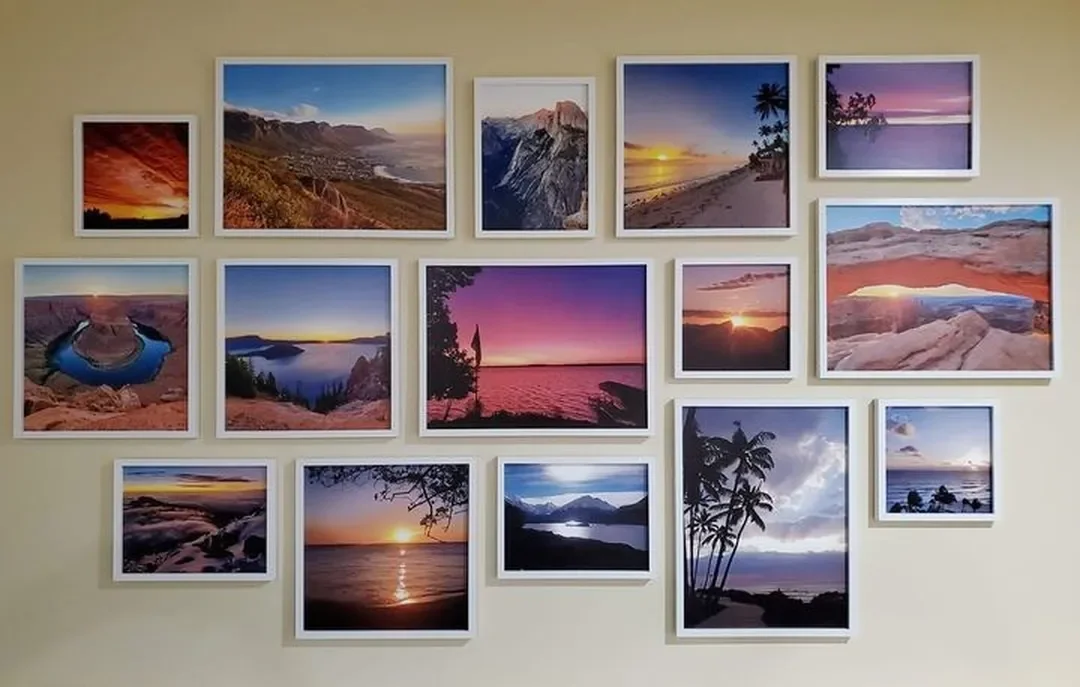
Pick a theme such as coastlines, national parks, or seasons. Unify color by applying a gentle, consistent grade across images so skies and greens feel related. Mix wide vistas with intimate details, for example a trail macro or a shoreline texture, to add rhythm. Balance verticals and horizontals so the arrangement feels stable. Not sure where to start? Follow our step by step tutorial on how to arrange art on a wall.
Layouts that look pro in any room
Grids suit modern rooms and offices. Rows work well over sofas and headboards. A salon layout feels playful for stairways or studios. Keep even spacing, about two to three inches between tiles in small rooms and a little wider in large rooms. Align with nearby furniture edges or door frames to anchor the view. For exact proportions and print dimensions, check our wall art size guide.
Printing that is easy, adjustable, and renter friendly
Mixtiles Photo Tiles and Canvas Prints are lightweight and framed without glass, so hanging is simple. Adhesive backs or wall magnets let you stick, lift, and rehang without tools. Gallery Wall Kits remove guesswork with curated layouts and templates. If you love licensed landscape art, browse Fine Art Prints and mix them with your photos for a layered look. Learn how to hang wall art without nails in any room.
Popular Mixtiles sizes for landscape images
|
Advertised Size |
Actual Size (inches) |
Actual Size (cm) |
Best Use |
|---|---|---|---|
|
8 × 11 |
8.4 × 11 |
21.35 × 27.94 |
Small shelves, hallways, starter gallery rows |
|
12 × 16 |
12.44 × 16.44 |
31.6 × 41.75 |
Above desks, kitchen nooks, balanced grids |
|
20 × 27 |
19.5 × 27 |
49.53 × 68.58 |
Statement pieces, anchors over sofas or beds |
How do you photograph landscapes you will be proud to print?
Plan for great light, compose with intent, and edit for print clarity. A few field habits and careful exports help your images sing on the wall.
Quick shooting tips
Use this short field list to get printable, high impact frames.
- Shoot at golden hour or blue hour for soft contrast and rich color;
- Add a strong foreground anchor such as rocks or flowers for depth;
- Use leading lines such as paths or rivers to guide the view;
- Keep the horizon level and avoid distracting tilts;
- Bracket exposures in tricky light so highlights and shadows are safe.
Edit for print, not just screen
Small adjustments increase legibility on paper and canvas.
- Refine contrast gently so details remain in bright clouds and dark trees;
- Preserve natural color balance so skies and foliage look believable;
- Remove dust spots and edge distractions with a quick cleanup pass;
- Export at full resolution in sRGB and keep sharpening modest;
- If you can, soft proof to preview paper contrast before ordering.
Landscape art helps us see and feel the natural world more deeply. From classical painting to modern photography, the genre blends light, space, and mood in ways that enrich your home. Now that you know what is landscape art, you can choose images wisely, compose with clarity, and print with confidence. With Mixtiles adhesive, repositionable frames and Gallery Wall Kits, you can design, refresh, and expand your landscape gallery anytime.
Bring your landscapes to life on your walls. Open the Mixtiles app or website, upload your favorite scenes, and create a beautiful, damage free gallery with our signature photo tiles. It's the easiest way to build the photo walls of your dreams.
Frequently Asked Questions
What are the main types of landscape art?
There is no single official trio, but many group landscapes into three broad types: realistic or representational views from observation, impressionistic or expressive studies of light and color, and abstract landscapes that simplify forms into shapes, lines, and textures.
What does “landscape” mean in art?
In art, a landscape is an image where natural scenery is the main subject. It focuses on landforms, water, sky, and light. Figures or buildings may appear, but they support the view. This differs from the geographic term, which describes real-world terrain.
What is the 70/30 rule in art composition?
The 70/30 rule is a simple composition guideline. Let one area dominate about 70 percent of the frame, and let the secondary area take 30 percent. In landscapes this often means prioritizing sky or land, creating clear hierarchy, balance, and visual impact.
Why is landscape art important today?
Landscape art connects people to nature, place, and memory. It reduces stress, celebrates light and season, and documents culture and environment. From museums to smartphone photos, landscapes remain a timeless way to express identity and bring calm, beauty, and meaning into daily life.

Be the first to know — deals, news & decor ideas.
By clicking you agree to the Terms of Use & Privacy Policy